Sicily’s subordinate status after Italian unification
The Florios of SicilySicily’s subordinate status after Italian unification is the persistence of conquest under a new national administration. The island is formally brought into a unified kingdom, but its people experience the transfer of power as rule imposed from outside: legislation, taxation, commerce, and administration are reorganized without meaningful accommodation of Sicilian conditions. The result is not simply political disappointment. It reaches into trade, public finance, shipping, and the Florio family’s sense of what it has built and who has the right to control it.
From Bourbon centralization to unification
The book establishes a recurring pattern in which sovereignty is felt through customs, taxes, restrictions, and the movement of goods. Under Bourbon rule, Sicilian political autonomy has already been curtailed: since December 1816, Neapolitans administer state offices and customs, and Neapolitan officers command the military. The loss of local power is accompanied by heavier taxes, restrictions, and new constraints on trade, bringing an already faltering economy to a halt. This earlier experience gives the later discontent a history. For Sicily, distant government is not an abstraction; it is a system that reaches the merchant’s accounts and the harbor’s operations.
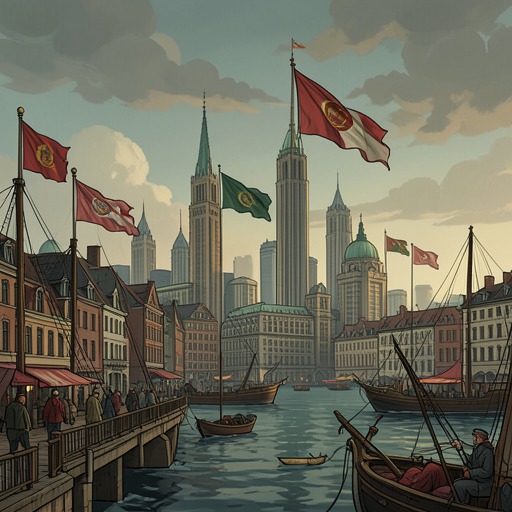
The Florios’ commercial world makes that pressure visible at the scale of daily business. Their spices travel through international supply chains, arriving from India through British suppliers and from French colonial markets by way of Italian sailors and Livorno. At the customs warehouse within the Palazzo Steri property, the family stores goods in transit or awaiting sale, paying import tariffs when merchandise enters Palermo rather than while it remains in bonded storage. The arrangement depends on rules governing customs and the movement of goods, and on the merchants’ ability to work across ports and jurisdictions. Political change can therefore interrupt not only local commerce but also a network extending through the Mediterranean.
The state’s claim on commerce and resources
Political upheaval repeatedly turns into a material demand on the Florios. During the 1848 revolt, a provisional government disrupts customs, outgoing ships are blocked, and goods face requisition. Ignazio Florio hurries to the Customs House after Ben Ingham reports that shipments are stalled; merchants and seamen crowd the courtyard while soldiers hold them back with rifles. The scene shows how abruptly political authority can seize control of the channels on which private trade depends.
Vincenzo Florio’s account of the revolutionary government makes the costs more specific. Acting for its committee, he has bought a large consignment of rifles from England. The revolutionary regime has also requisitioned ships and effectively compelled him to provide a loan. The Palermo, a vessel of the Sicilian Steamship Company that had been working at full capacity, is taken to transport troops. Since the revolt began, trading has fallen by half, affecting the merchant bank, the foundry, and the ships. Vincenzo recognizes Ruggero Settimo’s political conviction and willingness to reason, but the distinction between a cause and its financial burden remains sharp: he objects to a war being waged with the wealth he spent a lifetime building.
The state’s authority also has a constructive face. When Ferdinand II becomes king in 1830, his government promotes economic and social revival, infrastructure, engineering, railways, metal-hulled military ships, a pension system, and the first network of electric street lighting. It also seeks to improve the exploitation of sulfur deposits, bringing it into open conflict with British and French buyers intent on purchasing sulfur below market prices. The episode complicates any simple opposition between government and commerce: state policy can encourage technological development, but it also determines who controls resources and on what terms. In the mines, men and children emerge from winding underground corridors with baskets of yellow stone, which is weighed, bagged, and shipped chiefly to Britain, as well as to France and northern Italy. Sicily produces wealth, but the routes and bargaining power shaping its sale extend beyond the island.
Unification without accommodation
The historical account of unification presents the annexation as an unequal administrative settlement. After Italy is unified, officials from the Kingdom of Sardinia extend their legislative, economic, fiscal, and trading systems to southern Italy and Sicily without adapting them, and refuse compromise. The consequences cut across social groups. The nobility resent the loss of privileges and cultural identity; ordinary people continue to live with an economy operating under difficult conditions and with no apparent prospect of improvement. The narrative’s verdict is stark: Sicily is once again a conquered land.
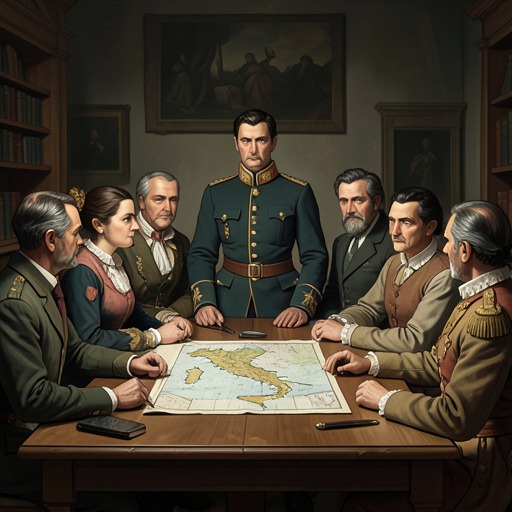
Giulia and Vincenzo’s confrontation gives that judgment a domestic and commercial voice. Giulia argues for the possible good of a single nation extending from the Alps to Marsala and asks Vincenzo to reckon with the lives sacrificed for the ideal. He sees the new rulers not as fellow citizens but as masters. In his view, the Piedmontese are turning Sicily into a colony, and the transfer of the Bourbon Crown treasury to Piedmont to cover the annexation campaign makes the language of national unity look like a farce. The argument is not only over political principle: it is a conflict between the promise of a shared nation and the island’s experience of extraction and command.
Florio independence and the limits of power
Vincenzo’s anger focuses on the danger that political subordination poses to Casa Florio. He insists that the family’s business does not stop at Messina and that he wants no one to touch the world he has made. He can bargain with the new authorities, but only from a position built on the services they need. They demand faster mail ships and threaten to transfer his contracts to Genoese companies; he is prepared to alter the vessels, provided they pay. He argues that the Florios are uniquely able to provide the coastal coverage required, and refuses to surrender what he has conquered through his own work. Commercial indispensability gives him leverage, but the threat to redirect contracts shows how readily the state can use administration to discipline even a powerful local firm.
His actions around the Royal Bank express a similar mixture of caution and vulnerability. With a crisis approaching, Vincenzo orders all cash and bank drafts transferred into the safe, intending to release the money back into circulation or convert it to the kingdom’s new currency once the emergency has passed. The gold ingots in the treasury cannot be secured in the same way: Garibaldi’s men are expected to requisition the substantial supply within hours. The scene places private prudence beside the state’s capacity to claim public wealth, while leaving the eventual destination of the gold uncertain.
The conflict exposes a limit in Vincenzo’s demand for independence. He resists dependence on any ruler or government, but Casa Florio’s contracts, ships, bank, and markets remain entangled with political power. Even as he bargains over mail service, the authorities can threaten his contracts; even as he protects cash, armed forces can requisition gold. His family’s commercial strength grants room to negotiate, not sovereignty.
The island as a continuing site of rule
In the years after annexation, Vincenzo continues to describe Sicily as being governed by outsiders who impose laws and officials without listening to those who know the island. He complains that the new authorities act like masters rather than sovereigns and dismiss local people as mistrustful while failing to understand them. In a later dispute, he objects that the Piedmontese have taken the Bourbon Crown treasury north to pay the costs of annexation. Giulia counters that he has always wanted matters to go his own way and asks him to consider the sacrifices made for national unity. Their disagreement leaves the political question unresolved: whether unification can be a common project if its institutions are experienced locally as a new form of command.
The consequences are both public and intimate. The island’s economic hardships and loss of autonomy persist beyond the change of regime, while the Florios must defend the enterprise they have created against the state’s demands and competing firms. Vincenzo tells Giulia that Casa Florio belongs to him and his son, drawing a boundary around family, property, and inheritance at the very moment he fears political interference. Sicily’s subordination thus becomes more than a constitutional condition: it is a lived contest over who may tax, direct, requisition, and profit from the island—and over whether the wealth made there can be governed by those who made it.